




If you’re searching for a 2026 Gartner Magic Quadrant for managed detection and response, you’ll likely come up empty. That’s the first thing to clear up.
In 2026, Gartner is still discussing managed detection and response through broader research on outsourced security services, market guides, and buyer reviews, not through a standalone Magic Quadrant for MDR. That matters because many teams start with Gartner when they need a fast, credible way to compare a crowded market.
So, when people search for gartner managed detection and response, the smarter move is to look past a single ranking. You need to know what MDR means today, why Gartner’s advice still helps, and what changed in 2026 before you shortlist providers.
Why companies look to Gartner when choosing an MDR service
Security buyers don’t go to Gartner for a shortcut alone. They use it to reduce uncertainty.
A strong analyst view helps teams compare service models, see where the market is moving, and avoid getting pulled in by polished sales pitches. That’s useful in MDR, where many providers sound similar on the surface. One says “24/7 response.” Another says “human-led threat hunting.” A third says “MXDR.” The fine print often tells a different story.
The buyer problems Gartner helps solve
Most MDR buying starts with pain, not curiosity. A company can’t staff a full-time SOC. Internal analysts drown in alerts. Cloud apps, identities, endpoints, and networks all create signals, yet no one has the time to tie them together.
Compliance pressure adds weight. So does the shortage of experienced security staff. As a result, buyers want outside help that can watch the environment around the clock and step in when something goes wrong.
This is where Gartner-style research helps. It gives structure to a messy decision. Peer feedback also adds color, which is why many teams check the Gartner Peer Insights MDR reviews alongside analyst research. Reviews won’t replace due diligence, but they can reveal patterns in onboarding, analyst quality, and response follow-through.
What to know before searching for a Gartner MDR report
Here’s the key point: you may not find a dedicated 2026 Gartner Magic Quadrant for MDR. That doesn’t mean Gartner has gone quiet on the space.
Useful guidance appears in broader research, including Gartner’s Market Guide for Managed Detection and Response and newer outsourced managed security research. Those sources are often more helpful than a simple ranking because they push buyers to look at service depth, operating model, and business fit.
The best MDR choice isn’t the highest-profile name. It’s the provider that can detect, investigate, and contain threats in your environment.
That shift in thinking matters. A provider can look strong on paper and still be wrong for your stack, your hours, or your risk tolerance.
What strong managed detection and response looks like today
Modern MDR is much more than a service that forwards alerts. It should feel like an expert extension of your security team, with people, process, and tooling working together.

Core MDR capabilities every buyer should expect
At a minimum, MDR should include 24/7 monitoring, threat detection, investigation, and a clear response path. If a provider only sends alerts and leaves your team to figure out the rest, that’s not much of a safety net.
Strong providers also offer threat hunting, incident reporting, and clean escalation steps. When a serious event hits, you should know who calls whom, what actions the provider can take, and how fast they act. Some teams want guided response. Others want active containment, such as isolating an endpoint or disabling an account.
The best providers don’t stop at “we found something.” They help disrupt the threat. That difference can decide whether an incident becomes a bad day or a business outage.
How MDR is expanding into MXDR, identity, cloud, and exposure management
A few years ago, many MDR services centered on endpoint telemetry. That isn’t enough now.
Attack paths often start in identity, move through cloud workloads, and blend with normal user behavior. Because of that, buyers now expect wider visibility across cloud platforms, email, networks, SaaS apps, and identity providers. In some cases, they also want OT coverage.
Public summaries of the Gartner MDR Market Guide point to another shift: MDR findings are expected to include more threat exposure context over the next few years. In plain terms, providers are being pushed to show not only what happened, but also where the environment is weak and what should be fixed next.
That’s one reason MXDR keeps coming up. It’s less about a label and more about broader, connected coverage.
The 2026 trends shaping Gartner managed detection and response decisions
The 2026 market is pushing MDR buyers toward outcomes, speed, and broader visibility. Hype is everywhere, so it’s worth focusing on what changes day-to-day security work.
AI is helping defenders move faster, but attackers are using it too
AI and automation can help MDR teams sort alerts faster, connect related events, and pull in context from multiple tools. That means analysts spend less time on repetitive triage and more time on real threats.
Still, faster detection isn’t the whole story. Attackers are also using AI to write more convincing phishing lures, test evasion tactics, and move at higher volume. So, buyers shouldn’t confuse AI features with better security on their own.
As of March 2026, public summaries of the 2026 Market Guide for Outsourced Managed Security Services point to the same message: choose providers that combine automation with experienced analysts and tested response playbooks. Machine help is useful. Human judgment still matters when the signal gets messy.
Security teams want outcomes, not just alerts
The market is also getting less patient with alert-heavy services. Buyers want proof that a provider can cut false positives, speed up containment, and improve visibility across the environment.
That sounds obvious, yet plenty of MDR sales motions still focus on dashboards and volume metrics. Those numbers don’t tell you whether risk is going down. Better measures include time to detect, time to contain, incident quality, and whether the provider helps your team make better security decisions over time.
The strongest providers feel less like a distant vendor and more like a working partner. They know your environment. They explain what they see in plain language. They help your team improve, not only react.
How to evaluate an MDR provider using Gartner-style criteria
This is where many buying teams get stuck. Marketing claims blur together, so you need a practical way to compare providers side by side.
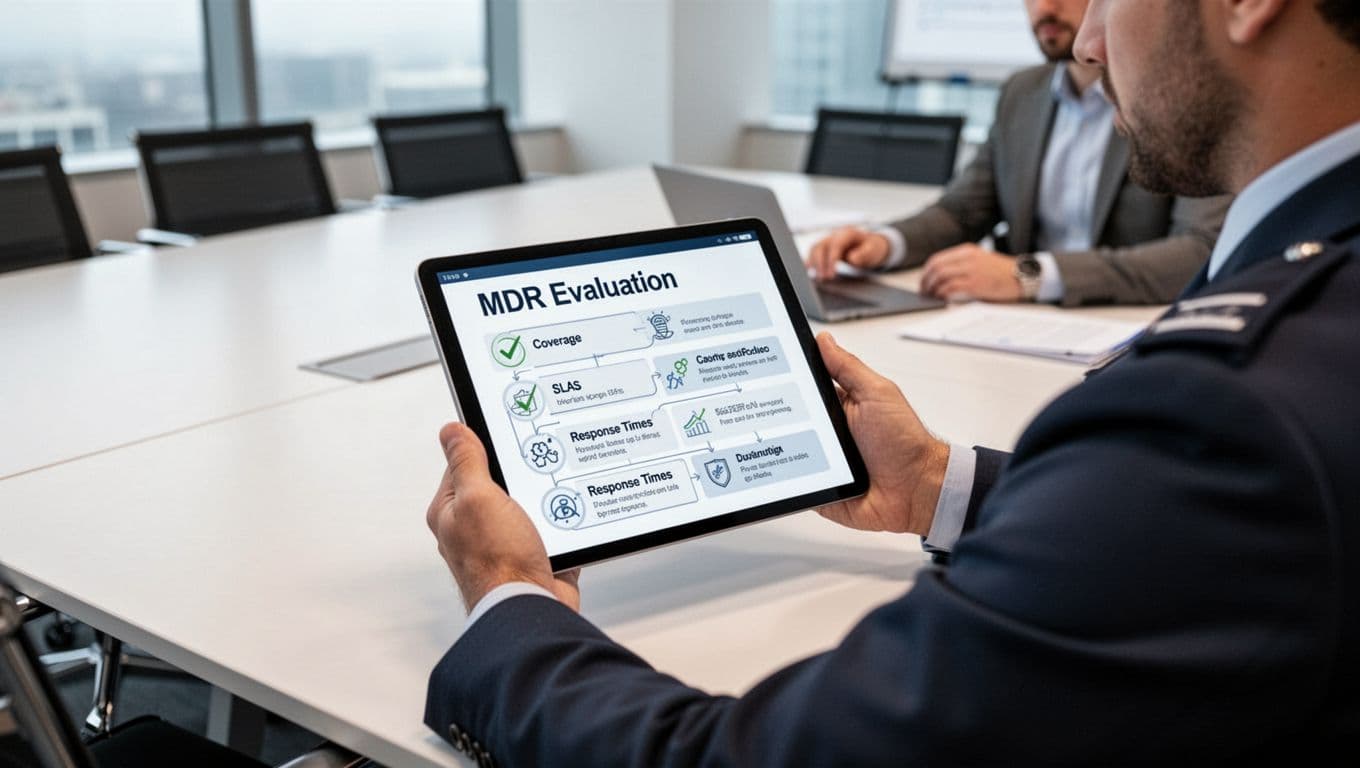
Questions to ask about coverage, response, and service depth
Start with a simple screen:
| Area | Ask this | Why it matters |
|---|---|---|
| Coverage | Are you truly 24/7, including holidays? | Gaps create blind spots |
| Data sources | Which cloud, identity, endpoint, and log sources do you support? | Coverage varies a lot |
| Response | What actions can you take without waiting on us? | Speed reduces damage |
| Handoff | How do incidents move to our team? | Poor handoffs waste time |
Then go deeper. Ask how long onboarding takes. Ask what SLAs apply to investigation and response, not only alert delivery. Ask for a real incident workflow, from first detection to containment, so you can see how the service works under pressure.
Also ask who does the work. Is the same analyst pool handling your environment, or are alerts bouncing between tiers with little context?
Signs a provider will be a good long-term fit
Good fit shows up in the details. Reporting should be clear, useful, and tied to business risk. You should have access to analysts when needed, not only a portal and a ticket queue.
Transparency matters too. If a provider won’t explain detection logic, response limits, or where tooling ends and humans begin, that’s a warning sign. The same goes for rigid service models that don’t fit your stack.
A strong long-term partner works with your existing tools where possible. They also help improve your posture between incidents, not only during them. That could mean better log coverage, tighter identity controls, or advice on recurring weaknesses seen across alerts and investigations.
In other words, don’t buy MDR as a fire alarm alone. Buy it as a security service that gets smarter with your team over time.
A Gartner managed detection and response search can point you toward the market, but it shouldn’t make the decision for you. Use Gartner research to understand service types, market direction, and buyer expectations, then test providers against your own environment.
The right MDR partner helps reduce risk every day. That’s the real standard, not a badge, not a ranking, and not a polished demo.
If you’re comparing providers now, ask one simple question: who will help your team contain the next serious threat fastest, and prove it?